Claude Code vs. GitHub Copilot: Why the 'Agentic Workflow' is Winning the AI Coding War
Published: 2026-02-09
Claude Code vs. GitHub Copilot: Why the 'Agentic Workflow' is Winning the AI Coding War
For the past few years, our relationship with AI coding has been defined by a single key: Tab.
GitHub Copilot pioneered this era. It turned AI into a sophisticated ghostwriter, sitting beside us and whispering the next line of code before we could even think of it. It made us faster, sure. But at its core, Copilot is a passive tool. It's a high-end autocomplete.
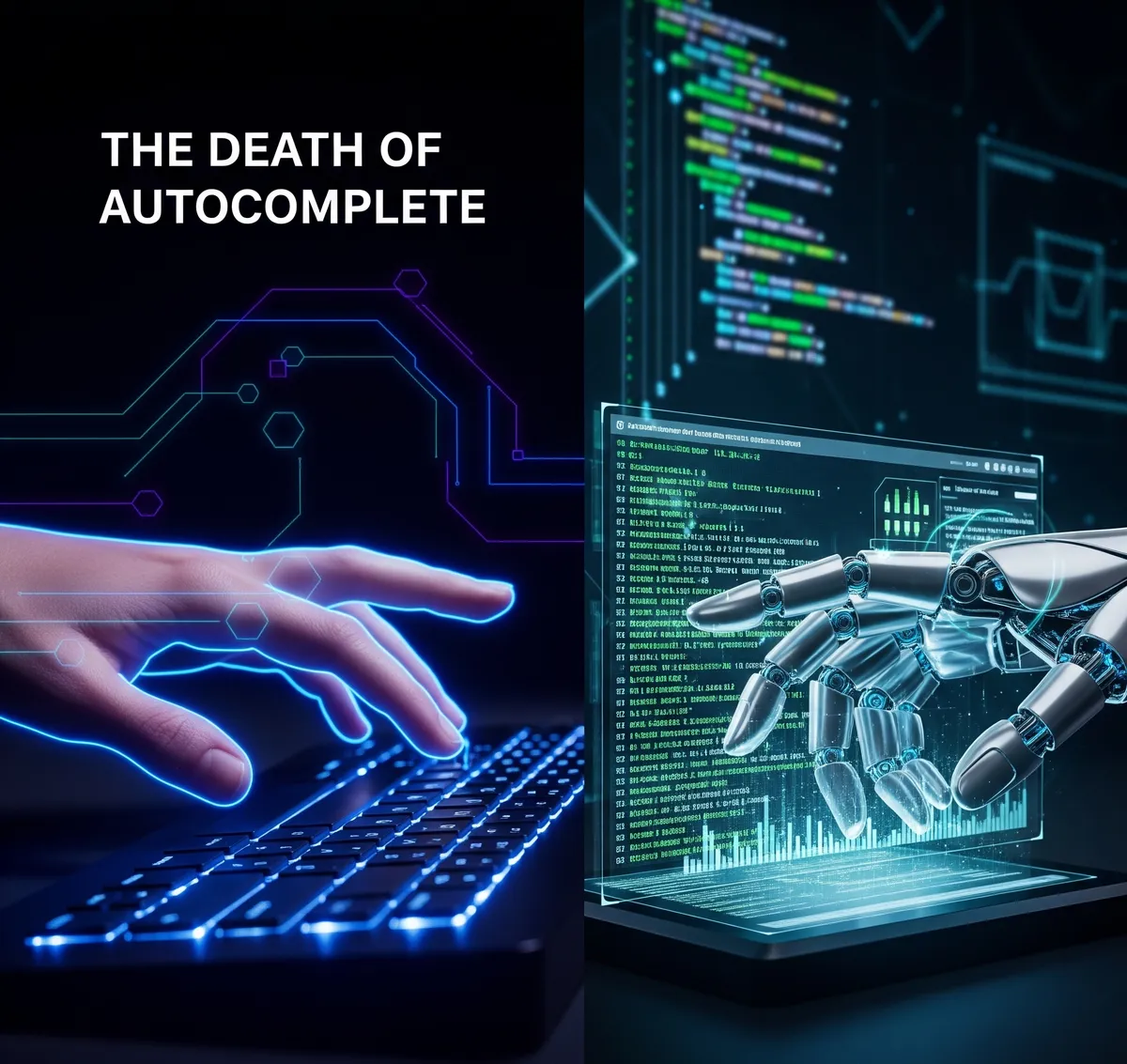
But the wind is shifting. With the release of Claude Code and the rise of agentic frameworks, we are moving away from "Autocomplete" and toward "Autonomous Engineering."
Here is why the Agentic Workflow isn't just a better version of Copilot—it's a total paradigm shift.
1. Reactivity vs. Proactivity (The Thinking Gap)
The biggest difference between these two tools is who takes the initiative.
GitHub Copilot is Reactive: It waits for you. You open a file, you start typing a function name, and it suggests a body. It operates within the narrow "window" of what you are currently doing. It's a brilliant assistant, but you are still the one driving every single turn.
Claude Code is Proactive: It is goal-oriented. When you give Claude a command like "Add a new Stripe billing endpoint," it doesn't wait for you to open the right files. It "thinks." It scans your directory, finds where your other API routes live, checks your database schemas for user IDs, and looks at your existing middleware.
The Shift: You stop giving instructions on how to write code and start giving instructions on what goal to achieve.
2. The Toolbelt: AI with Hands
If Copilot is a brain in a jar, Claude Code is a developer with a workstation.
The secret weapon of the agentic workflow is access to the Terminal and Filesystem. Claude doesn't just suggest text; it can execute commands.
The Copilot Loop: AI suggests code → You copy/paste → You run tests → You see an error → You paste the error back to AI → AI suggests a fix. You are the middleman.
The Claude Loop: You give a task → Claude writes code → Claude runs npm test → Claude sees the stack trace → Claude fixes the code autonomously → Claude runs tests again.
When the AI can "see" the output of the terminal, the feedback loop closes. You are no longer the bridge between the editor and the console; you are the supervisor of a self-correcting system.
3. Local vs. Global Context
We've all been there: Copilot suggests a perfect-looking function, but it uses a library version you deprecated six months ago, or it forgets that you have a specific utility function in a different folder.
Copilot's context is largely "what is in front of your eyes" (the open tabs).
Claude Code uses "Deep Context." Because it can navigate the entire repository, it understands the hidden dependencies between modules. It understands that changing a type in models/user.ts will break a component in ui/profile-card.tsx and can offer to fix both simultaneously. It's the difference between a magnifying glass and a satellite map.
4. Case Study: The "Dirty" Refactor
Let's look at a real-world scenario: Refactoring a messy, 500-line legacy module to follow SOLID principles.
The Copilot Way: You'd spend an hour manually breaking the file apart, asking Copilot to "extract this logic into a class," checking for broken imports, and manually moving files. It's still manual labor, just with a better dictionary.
The Agentic Way: You type: claude "Refactor legacyOrderService.ts into smaller modules using the Strategy pattern. Ensure all existing integration tests pass."
Then, you watch. You see the agent create three new files, update the dependency injection container, and run the test suite 12 times until the red bars turn green. You haven't touched the keyboard; you've been busy reviewing the architectural decisions.
5. From "Coder" to "Orchestrator"
This is the most important takeaway: Agentic workflows change your job description.
In the Copilot era, you are still a "Coder." You are responsible for the syntax, the line-by-line logic, and the manual integration.
In the Claude Code/Agentic era, you become an Orchestrator. You become the Architect and the Manager. Your value is no longer in how fast you can type for loops, but in how well you can define requirements, verify security, and judge the quality of the agent's output.
This shift saves roughly 70% of your "mental RAM." By offloading the mechanical steps of coding to an agent, you can focus on the hard problems: system design, user experience, and business logic.
At a Glance: How They Compare
Since Medium doesn't love tables, here is the breakdown of how these two paradigms stack up against each other:
Primary Interaction: Copilot lives in your Editor (Ghostwriting); Claude Code lives in your CLI (Task Execution).
Initiative: Copilot is Reactive (waits for your cursor); Claude Code is Proactive (takes a goal and executes).
Environment Access: Copilot is Isolated (read-only); Claude Code has Full Access to your terminal and filesystem.
Problem Solving: Copilot requires You to provide error logs; Claude Code Self-Corrects by running your test suites.
Context Depth: Copilot sees Open Tabs; Claude Code maps the Entire Repository.
Best For: Copilot is for Quick Boilerplate; Claude Code is for End-to-End Features.
Final Verdict: Which One Should You Use?
Is GitHub Copilot dead? No. Copilot is still an incredible tool for "flow state" coding—when you know exactly what you're doing and just want the boilerplate to appear instantly. It's a scalpel.
However, for everything else—building features from scratch, fixing complex bugs, or managing large-scale refactors—Claude Code and the Agentic Workflow win by a landslide. We are moving past the era of "AI that helps us write." We have entered the era of "AI that helps us build."
Which one are you ready for?
If you found this helpful, follow me for more deep dives into the changing world of AI engineering.