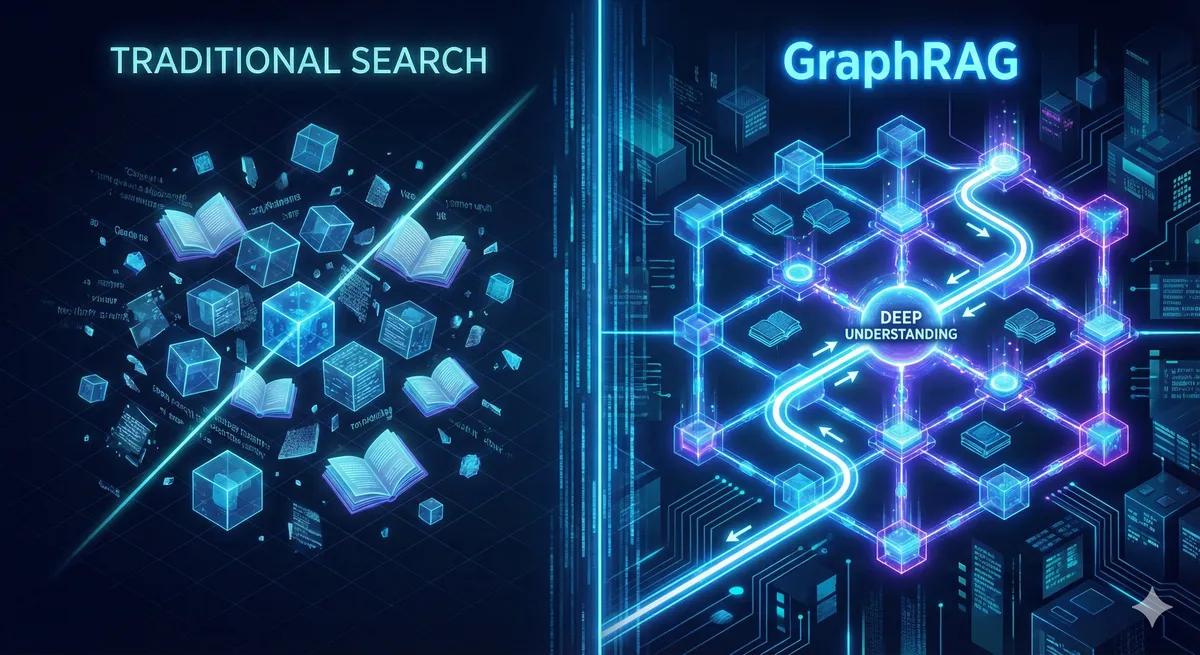
GraphRAG – Why Vector Search Alone Isn't Enough
In the world of artificial intelligence and RAG (Retrieval-Augmented Generation) systems, one approach has long dominated: vector search. It worked great as long as our questions were simple. However, as systems became more complex, we started hitting a wall.
Why does your vector database sometimes fail to "understand" context, and what exactly is GraphRAG? Let me give you a brief introduction.
The Problem: The Wall That Classic RAG Hits
Most RAG systems work according to a simple scheme: we split text into chunks, convert them into numbers (vectors), and search for similarity. This works perfectly for questions like "What is X?"
The problem appears when we need to connect the dots.
Imagine visiting a library:
- Vector search is like looking for a book by the color of its cover and a few keywords. You'll find what's visually similar.
- GraphRAG is like asking an experienced librarian. They know that the author of this book was inspired by another title that sits in a completely different section, and they can explain the relationship between them.
Summing it up in one sentence: Vectors find similarity, Graphs find relationships.
What Exactly Is GraphRAG?
GraphRAG is an approach where a language model (LLM) doesn't just answer questions, but first helps build a knowledge map – a so-called Knowledge Graph.
Instead of loose text fragments, we create a structure composed of two elements:
- Nodes: These are "things" (e.g., file name, author's name, specific concept).
- Edges: These are relationships between them (e.g., "uses", "is the author of", "influences").
Thanks to this, the system doesn't just see words – it sees connections.
Real-Life Example: Program Code
This is best seen with a code example. Let's say we ask the question:
"How will a change in the Login module affect the Reports module?"
-
Classic (Vector) Approach: The system will find files where the words "Login" and "Reports" appear. If these two modules aren't described in the same file – the system will probably get confused or say "I don't know".
-
GraphRAG Approach: The system will look at the graph and see the path:
Login → is used by → User Session → is used by → Report Generator.
The model "sees" a connection that isn't explicitly written in the text. It understands the architecture, not just the vocabulary.
When Is It Worth Considering?
GraphRAG is a powerful tool, but it's also more expensive to build than a regular vector database. When is it worth implementing?
- When data is complex: Law, medicine, supply chains, source code – everywhere that everything is interconnected.
- When you ask "Why?" and "How?": Plain vectors are great for facts. Graphs are essential for reasoning and knowledge synthesis.
- When you need broad context: Sometimes an answer requires understanding "the whole picture", not just finding one paragraph.
Summary
Moving from regular RAG to GraphRAG is an evolution from a word search engine to a knowledge understanding system.
You could say that in the context of technical documentation, classic RAG is like an intern with the command "search in text" (grep), while GraphRAG works like a Senior Developer who knows the system architecture and understands what follows from what.
The best results often come from combining both worlds – the speed of vectors and the wisdom of graphs.