Where Did My Words Go? – Understanding the Embedding Layer in AI
Published: 2025-12-25
Where Did My Words Go? – Understanding the Embedding Layer in AI
Have you ever wondered what ChatGPT or another language model actually "sees" when you type a sentence into it? For us, text is letters, words, and meanings. For a computer? Text is an illusion.
If you want to understand how modern Transformer models (like BERT or GPT) work, you need to grasp this one crucial moment right at the beginning: the instant when words stop being words and become a mathematical map of meaning.
Today, we're going to peek under the hood and discuss the Embedding Layer.
Introduction: Text is Just an Agreement
Before we even touch the neural network, we must accept a brutal truth: AI models can't read. They don't understand letters or words the way we do. They only understand numbers.
That's why the first step is always Tokenization. This is the process where we chop our sentence into pieces (tokens) and convert them into numbers from a large vocabulary.
Let's take an example:
Sentence: "Hello world !"
The model will add special start and end markers (like <bos> and <eos>), then convert this into a sequence of integers (indices). It might look like this:
[12, 15496, 2159, 5145]
This is where linguistics ends and mathematics begins.
Starting Point: Input IDs
Before actual processing begins, we have raw input data. In the AI programming world (e.g., in the PyTorch library), we store this in a structure called a Tensor.
Our input tensor has a very specific shape:
[batch_size, seq_len]
Let's decode this:
- batch_size (e.g., 1): How many sentences we're processing at once. In our example, it's one sentence.
- seq_len (e.g., 4): The length of the sentence (number of tokens).
So we have a simple, two-dimensional array:
[[12, 15496, 2159, 5145]]
Where's the Problem?
Look at these numbers. Is the number 15496 mathematically close to 2159? Not necessarily. These are just catalog numbers. It's like saying that a book with call number 500 in a library is thematically similar to book 501. They could be about completely different things.
This is where Embedding comes in. We need to convert these "flat" catalog numbers into something that carries meaning.
The Key Transformation: The Giant Table
What is an Embedding Layer? The simplest way to think about it is as a giant Lookup Table.
Imagine a table with as many rows as words the model knows (e.g., 50,000). But that's not all. Each word in this table has assigned to it a unique, long sequence of numbers – a vector.
When our indices [12, 15496...] hit this layer, magic happens:
For each index (e.g., for the word "Hello" with ID 12), the model "pulls out" from the table the vector assigned to it.
Dimensional Change – THIS IS KEY
This is the most important moment in today's post. Look at what happens to the shape of our data:
Input: [1, 4] (Flat list of indices)
Output: [1, 4, 768] (Three-dimensional representation)
Where Did This 768 Come From?
This is called the embedding dimension (or hidden_dim). It's the size of the vector that describes one word.
Instead of a single number (e.g., 12), the word "Hello" is now represented by a list of 768 numbers:
[0.12, -0.45, 0.99, ... , 0.05]
(and so on, 768 times).
Why Do We Need These 768 Numbers? (Semantics)
You might ask: Why complicate things? Why does one word need to be described by as many as 768 numbers?
The answer is: Context and Meaning.
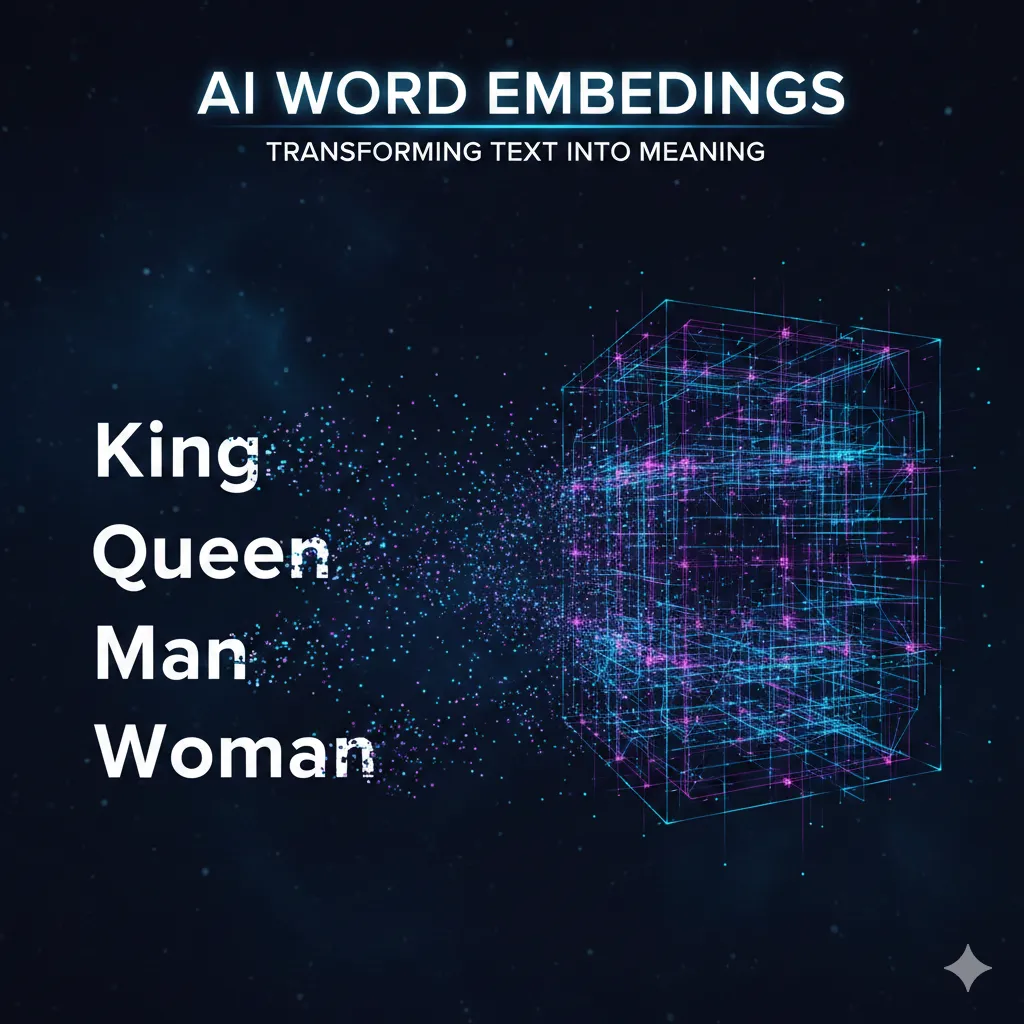
A single index (e.g., 8848 for the word "King" and 9584 for "Man") tells us nothing about the relationship between these words. But in 768-dimensional space, the vectors representing these words can be mathematically close to each other.
Thanks to this "depth":
- The model can encode in numbers the information that "King" is someone "Royal" + "Male"
- "Queen" will be found in this space close to "King," but shifted toward the "Female" trait
The embedding layer is the foundation. Without this dimension (hidden_dim), the Attention mechanism that comes later would have nothing to work with. You can't analyze dependencies between words when you only have their library numbers.
Summary (TL;DR)
If you remember one thing from this post, let it be this data shape transformation:
We enter with a flat sheet of paper:
➡️ [Batch, Sentence Length]
We exit with a three-dimensional data block:
➡️ [Batch, Sentence Length, Depth (768)]
Only now, with this three-dimensional structure full of mathematical meaning, is the Transformer ready to "think." But that's a topic for the next post!